Well me, of course. When I offered a prize back in April to whoever could name the location of the phone box pictured in that month’s entry, it was a hollow offer. Being an anonymous blog, I can hardly identify the person who left a comment with the correct answer. But having ‘moderated’ it, you will find it by clicking 'April' (right.) And if you are reading this for the first time and want to know what this waffle is about, you might like to start in January (click 2011 and Ctrl+Pg down), and follow the phone-box trail, while I tuck into my crème egg, twisted.
The real winner, however, has to be my Dad, who (for those who follow this waffle top-first) is thankfully on the mend, and managed to escape hospital in time for Hogmanay. Having posted on here some of the black-and-white snapshots that make up childhood memories, it seems that certain elements of his formative years have caught up with him in old age. Or is it too easy to say that a childhood in a deprived area of a large city, with malnutrition, economic depression and impending war should result in osteoporosis some seventy-five years later? Probably – but who knows?
As children, we like to blame our parents for the way we turn out; conversely (or do I mean; likewise) our parents shoulder a disproportionate responsibility for the things we do, be they right or wrong: parental pride and shame go hand in hand it seems. Maybe it was my ancestors who were responsible for clearing their own people off the land that was theirs; an act for which all Scots ought to be ashamed. This is the ever-deepening coastal shelf that Larkin speaks about (I took his advice and never had kids myself), or the crumbling spine that links my father to his apparently ‘deprived’ childhood. I’ve never, in stories of his youth, heard him describe it as such.
Everything changes, as the poets and pop-song lyricists say. Some put it this way: we plant trees for those born later. Others say, they took all the trees and put them in a tree museum. But a third, on the subject of growing older, said ‘Every day won from such darkness is a celebration.’ The same poet (points if you know who) said ‘God punishes regret.’ I took these lines to my heart from the second I read them, and they have been a mantra every bit as meaningful as the prayer for serenity attributed to Thomas Aquinas (the only ‘prayer’ I have ever heard my father attempt to quote)
My dad’s old secondary school is now a pub, something of a museum itself, with memorabilia, old photos, and a host of accoutrements that reflect the past, just as the mirrors behind the bar show us just a little bit of who we are as we order our beer, before our eyes get too misty or maudlin with nostalgia or alcohol – or a heady mixture of all four. This is the trouble with the past. Some dismiss it as irrelevant; others resign it to history; but there are those who spend each day regretting it, trying to re-write it, wishing they could scrape the slate and start again.
So I end this year’s bloggage with the final photo from my dad’s Glasgow Schooldays Calendar, ‘The Old Schoolhouse Pub,’ with a tinge of sadness that, although I chose this picture for the month of his birthday, he hasn’t seen much of it from his hospital bed. Furthermore, I can’t help but regret that the phone box in front of the building is not the one that may or may not have stood there when he sneaked in through the side gate (to avoid the prefects reporting him ‘late’) but one of those I most despise (or dislike).
If I could be bothered, I could do a wordpaint-job and turn it into a tacky picture like they sell in TK-Maxx, with red phone-boxes, routemaster buses, or pillar-boxes super-imposed on black-and-white pictures. Sometimes, you just have to accept things as they are. My dad has never needed God to give him that serenity. I don’t know where he gets it from; it would be like asking someone ‘what is jazz?’ As the great Satchmo said: if you have to ask, you’ll never know. Of the many things my dad has taught me over the years, it is for the most inexplicable that I remain eternally grateful. Here then, as this year turns into the artificial past, is a ‘prayer.’
Teach me, Dad, serenity…
to accept the things I cannot change,
courage to change the things I can,
and wisdom to know the difference.
Saturday, 31 December 2011
Sunday, 18 December 2011
What is Normal?
This year I’ve made a distinction between ‘normal’ and what I call ‘posh’ schools. I don’t wish to qualify this, except to say that neither ‘public’ nor ‘private’ schools can be described as ‘posh’ any more. Both are exclusive, in that they exclude those who do not (or cannot) choose to use their money to improve the education of their offspring.
I think my views on how tax is spent on warfare, to the detriment of decent education, public services and healthcare for all make my position clear when it comes to what I see as ‘normal’ schooling. But this, like the nomenclature of privilege, is just a name.
What’s in a name?
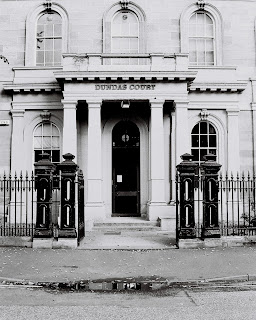
My dad’s old school was indeed called The Normal School (it was thus, on the front of the tram whose route the Normal School was on.) It is now a business centre. And my alma mater, which moved several years ago (to a former Naval College – a fine location despite all that); the old building where I studied is now a School of Economics – surely the antithesis of an Arts Conservatoire?
I am of the type of personality for whom ‘normality’ is strange, and ‘ordinariness’ is at best a watchword; at worst, an area of utmost avoidance. Yet I’m glad my dad went to a ‘normal’ school. Being ‘ordinary’ doesn’t mean, lacking unintelligence, or talent, or ability. My dad has this and more. I just wish he didn’t have to spend the end of this anniversary year in hospital, at the mercy of an under-privileged National Health Service.
Wednesday, 30 November 2011
Now You See it…
Today, being St Andrew’s Day, the Burghers of Dunedin were allowed to look around their own castle – for free! It was good to maunder about and hear local accents, in all their rich variations. My favourite sight (aside from the exhibits, given that it’s mainly an elevated War Museum) was an Asian family who’d gone up there with a take-away, and sat up on the ramparts on a park-bench, opening the foil containers. Curry on the Castle! And why not: it’s their Castle too.
As for the rest of our St. Andrew’s Day celebrations in Edinburgh , the launch of a new exhibition at the Museum of Scotland , and the long-awaited re-opening of the Scottish National Portrait Gallery were both postponed due to industrial action. I’m not sure I go for Nationalistic Pride; it’s mostly puffed up and proud, rather than a genuine sense of taking pleasure in who we are or what we have achieved, as a Nation.
My second-favourite sight was a pair of phone-boxes, tucked inside the Castle entrance, which I snapped with my mobile phone just before it got dark (at about half-past two.) Surely a National Emblem of who we are, as British, not just Scottish; but sadly, it is mainly seen as sentimental or nostalgic – or a tourist photo-opportunity. When I first came to live in Edinburgh , there were twelve red phone-boxes along the Royal Mile – including the two inside the castle.
Now there are eleven.
Where did the twelfth – dare I call it the Judas phone-booth – go, I hear you call out. It just happens that I have in my sad collection a before-and-after shot. Some ten years ago, when the over-budget building-site on Abbey Strand was the subject of as much heated debate as the trams are today, a wee red box stood, snuck into a corner by The Queen’s Gallery. With a bit of Scottish Imagination, they could have used it as a Security Box. I suspect this was reason it was removed: for ‘security’ – which is another word for institutional fear and public paranoia.
A phone-booth’s a phone-booth, for a’ that, said the Bard (at least, he might’ve). Maybe, but not when you look at what has replaced our Great British Beacon. As you travel down this famous thoroughfare (which, I accept, is not altogether consistent in its architectural or cultural display) that links the Castle to the Royal Palace, you'll see the Saint Matthias Phone-booth, one of many ugly and totally impractical designs which have replaced the faithful red box; the 13th Apostle chosen to spread the word in the absence of the betrayer (or betrayed).
It’s not even a box: it’s an abomination! But some would say the same about the Parliament Building , the trams, or more importantly, the social, cultural, and economic apartheid that divides this silly wee country, and stops us from being truly proud of who we are. If Scotland should ever gain independence from England (or do I mean, Britain ? Nah – England ) it will take more than whisky, tartan, tins of shortbread and North Sea Oil to sustain an economy. It will need the Guid Scottish Citizens to stop arguing with themselves. But that is a National Occupation, right enough.
I have a strong belief that the only thing that will save the world is Art – the ‘lie’ that helps us to understand the ‘truth.’ Last week, I went to the Scottish National Gallery to hear a singing harper performing traditional Scots airs, as a prequel to St Andrew’s-tide. Once I’d struggled past the crowds on Princes Street and The Mound, gathered to see the ‘Christmas Lights’ being turned on, I discovered that the performer had not been able to get through the throng with her clarsach, and the recital had been cancelled (or postponed, perhaps – I do not know.)
So commerce and consumerism had won over Art and Music, once again. Yet I take hope from one thing that I learned at the Castle today. When the King of Scotland plonked his hoary arse on a lump of stone and said, ‘Aye, Right,’ he was invested with other emblems of kingship (besides a cold bum or piles, assuming he was a true Scot.) A sword, representing Justice, or Defence (righteousness or aggression – you decide); a sceptre, to rule with discretion and integrity; a reliquary shrine, for taking of the oath, and finally; a bard, to recite the king’s genealogy. A poet – hurrah!
Art is important. More than that, it is imperative. In his Lament for the Makaris, William Dunbar lists some of the things we celebrate as Scottish:
Art magicianis and astrologgis,
Rethoris and theologgis…
In medicine the most practicianis,
Lechis, surrigianis and physicianis…
And he goes on to lament that none of these can be delivered from death. But if Art exists outwith time (as some view the existence of God), then we have art and music, design and architecture, photography and literature, poetry and sculpture – et cetera. The best of Scottish. And there, standing tall in the Museum of Eternity is my old friend, the Phone Box. Designed by a Scot, I’ll have you know. (Well, sort of: Sir Giles Gilbert Scott.) Let it wear its perforated crown – with pride.
Friday, 11 November 2011
I Remember
There’s a slogan that gets printed on posters and postcards, tea-towels and tee-shirts that says, “It would be nice if hospitals and schools had all the money they needed, and the Army had to hold jumble sales to buy guns.” This month’s Glasgow School Days calendar-picture is of the Children’s Hospital that stands around the corner from the flats where my father used to live (which no longer stand), and holds other memories for him. At least, he thinks it does: it was a long time ago.
But it’s easier to bang a soap-box than rattle a collecting tin.
However, while I’m at it, here’s another story about an old man who trundles his shopping trolley up the Royal Mile every day in summer (and maybe winter too, though I’ve never seen him) to collect, “For Charity, for Charity.” Tucked in a doorway on Castle Hill, with photographs of unknown soldiers, looking like a veteran in kilt and regalia, he churns out the same old banter: “Open up your hearts – for the wounded soldiers – open up your cold, cold hearts – for charity, for charity…” and so on.
When tourists stop to take a picture, he shakes his money-box (bona fide, one assumes – it would be uncharitable to suggest otherwise) like a fist: “Ohhh-pen up your hearts,” he sings. Guilt is a wonderful thing. He also, I should mention, collects for Edinburgh Sick Kids Hospital . Does he divide his collection exactly by half, as he should, I wonder? Or does he siphon off some to pay for his woolly knee-socks? That’s being uncharitable, again – he is very old: “I’m ninety-one, you know,” he tells us – although this is not a constant. Sometimes his alleged age goes down as well as up.
It seems unkind to criticise. But the balance between improving the lives of sick kids and those who, as an occupational hazard, have been maimed in battle – no arms, no legs, according to the old man’s prattle – seems disproportionate, if not slightly distasteful. At this time of year, we are forced to emphasise a desire for keeping alive the memory of those who were killed, supposedly for King (or Queen) and Country, over keeping children alive. The public act of Remembrance is marred by every war that rages, and every act of violence that is carried out in someone else’s name.
I can hear dissent cry out, in warped interpretation of the Gospel message: ‘They died that we might live.’ Well, sorry, but that’s bollocks. I may or might not be alive today, whether we had been defeated by Hitler’s troops, lost the Falklands to the Argentineans, or failed in any other of the many disgraceful conflicts in which our country has sent troops, some of them barely more than kids, to die, be maimed, or to suffer appalling damage so that we allegedly might be free.
Free from what? I would like to be free from the notion that any form of violence is legitimate or acceptable, and that of all institutions, the Church would disassociate itself from the gratuitous glorification of war when it (rightly) remembers all those who suffer as a result of conflict. This is why I wear a white and a red poppy together. At least, I used to, but I got fed up explaining the reason or worse, putting up with the abuse I received.
These days, I wear neither, if I can get away with it. Unfortunately, I will be required to wear the red one, while I am being paid to sing a setting (by Elgar, if it could get any worse) of that horrific piece of jingoistic doggerel, For the Fallen; the most disgusting poetic romanticising of warfare I have come across. I wonder what Laurence Binyon, with his Quaker upbringing, would have made of Elgar’s highly nationalistic setting, packed with pathos and patriotic fervour. Very moving, if you like that sort of thing.
Certainly, the verse which most people know (that Binyon wrote before the rest of the poem) contains an acceptable sentiment; that we should remember those who have ‘gone before us.’ Gone where, I wonder. Then again, I don’t really wonder: they are dead; they haven’t ‘gone’ anywhere. At least these four lines can be interpreted universally, without reference to “England ’s dead.” In Scotland , a warped Nationalistical Correctness insists we change the words to ‘Britain ’s dead.’ Frankly, I’d rather disassociate myself from English military fervour, although Scotland is pretty keen on celebrating the accoutrements of conflict. Look at the Edinburgh Tattoo.
The rest of the poem is packed with romantic language, pathetic fallacy and euphemism. England is the Mother who mourns; the sea is foamy (what: like soap-suds washing our bloodied beaches? Nice); their brave young hearts are likened to eternity itself; they ‘fell’ – as opposed to being gunned down, blown up, or gassed to death. Have a look at the poem (that is, if you are still reading this rant) and see for yourself: is this genuine sentiment, or just sentimental; the embodiment of the ‘old lie’ as Wilfred Owen put it, that it is sweet and fitting to die for one’s country?
Binyon’s memorial in Westminster Abbey has inscribed upon it what Owen claimed was the subject of his poems, the pity of war. With this in mind, it seems to make sense that For the Fallen could be ‘read’ in that light – as long as it’s without the stirring sounds of Elgar’s painfully chromatic setting. Or without the screeching noise of massed bagpipes and drums that pound across the Castle walls every evening for a month in the summer, followed every subsequent morning by the long-held notes of the shouty wee man: “Ohhhhh-pen up your hearts!” I suspect he makes a mint at this time of year, and I imagine he wears a rather large poppy.
When it comes to conflict, silence is a dangerous weapon. What is left unspoken, or is covered up or camouflaged in politics, often leads to deeper divisions than those it seeks to cure. The rhetoric of Remembrance has, at its core, the notion that, by holding ever-lengthening periods of silence to honour the dead, whether killed ‘in action’ or slain by some other form of collateral misfortune, is an acceptable way to show our respect. Surely it would be far more respectful to turn our swords into ploughshares?
It would be nice if the words ‘I renounce violence, in all its forms’ were included among the Baptismal vows of the Church. By renouncing sin, the devil, and other amorphous abstractions, violence seems to wriggle out of the equation – or into it, depending on your point of view. Well, I renounce silence. And since all I can do is publish this polemic on an anonymous blog that few will read, and even fewer approve, I will add my voice to the debate, and my craft to the canon of pitiful war-poetry. This is my version of Binyon’s poem, which follows the form and rhyme of the original, but not, I suspect, the sentiment for which it is commonly recited.
Passing Bells
With pitiful ingratitude sobs a single mother,
Mourning for her sense of lost democracy;
For her misplaced pride when her son signed up
To be slaughtered abroad for the Land of the Free.
The pounding beat of the BBC headlines pump out
Rolling news with eternal glee; the upbeat jingle blears
Our teary eyes of truth – death seen as a celebration –
And the short-lived shame of political smears.
Like the gun-shot preceding the EastEnders theme-tune,
The drum-roll leading to ‘God Save the Queen’ flowed
Through their vain, young hearts. They took a chance,
And turning, faced the truer foe.
“My only son is dead. My flesh-and-blood is cold,
While I grow old and sour – bitterly condemned
To remember. Every November? Every waking hour!
How can I ever forget him?”
She keeps his picture on the mantle-piece, in his uniform;
Leaves his bedroom as he left it, plumps the pillows,
Dusts, every day, the photo of him and his sweetheart,
Keeps his number in her mobile-phone.
But these are the names that we still remember:
Bush, Blair, Thatcher, Powell, Rumsfeld, Albright.
‘Their families have been informed,’ we are told.
Oh well; good. So that makes it alright?
As the death-toll is glibly announced on the news,
We are all collaterally damaged by short-lived stardom.
A lone bell tolls a tally, as it is on earth, but not in heaven.
It is here. Here is death’s dominion.
For more information on the White Poppy, see the Peace Pledge Union
Today, I refuse to keep silence until The Church and The World renounces violence. Honour the dead by turning their swords into ploughshares; their guns into garden forks.
Monday, 31 October 2011
Haunting Memories
Tonight I heard a spooky piece of music on Radio 3 about a telephone. I wondered if I should compose a partner piece about a telephone box. Where do the ghosts of dead telephone kiosks hang out? While we’re on the subject of museums; what happened to the phone-boxes that were mercilessly ripped from our city streets, historic towns, quant villages greens and country-side verges for reasons that I struggle to accept? Some have ended up in private gardens, cafés and pubs; others, made into cocktail cabinets, shower-cubicals and, in what you might call post-modern irony, domestic phone-booths.
Who cares – nobody’s listening, are they.
There's a ghostly silence at the end of this line
Monday, 17 October 2011
Paradise, Paved
We’re over half-way through October and I have realised, in my neglect of the Window, if not the Turret itself that we are behind with the Glasgow Schooldays calendar. To rectify this: a picture of another window, or at least, another view. With Autumn presenting as it does to some death and decay, others may prefer to think of a deepening of roots, or perhaps, new vistas. Here then is a juxtaposition of the old and the new.
Through the charming art deco window of the Scotland Street School Museum a grim and ugly multi-storey car-park. On one side of a busy road, a parking lot, on the other… well, not quite paradise. Maybe one day, schooling as we know it will be a thing of the past, and they’ll turn every school into a museum (and charge all the kids a dollar and-a-half just to see ’em?) Some schools, of course, charge the kids (or the parents) more than a dollar and half to attend. But I’ll leave that paved paradise for another pro-utopian rant.
Friday, 23 September 2011
Endangered – but not dead (yet)
At the moment, the streets of Edinburgh are dotted with brightly coloured models of endangered animals. It’s a bit like the Cow Parade, only now there are tigers, elephants, crocodiles and exotic birds I cannot name. But spare a thought for the good old telephone box, I say: it’s been in danger for some twenty years or more, ever since Thatcher got her evil claws in and sold off what we rightly owned, even the very water from the sky.
But could they have made the film Local Hero without that iconic landmark? Even Doctor Who has resorted to its lure. Think of all its uses, besides making that all-important phone-call when your mobile’s out of battery. What other booth has been so perfectly designed to provide adequate cover to urinate, procreate, or change into a superhero? And to prove it, Innocent Smoothie pays homage to the humble phone-box, with its cut-out superhero movie kit printed on the side of the 750ml mango and passion fruit carton.
Subscribe to:
Posts (Atom)