Monday, 31 December 2012

Here Endeth the Year

And so, I reach the end of this year’s sequence of sestudes.  I have spent many hours wandering around the Museum of Scotland, reading up on each object in the Research Library, and sitting in various nooks to scribble in my notebooks as inspiration struck.

I even visited the Collections Centre in Granton (on Doors Open Day) where there are a million-and-more pieces of treasure that haven’t made it into the Museum.  Maybe I’ll write a sestude or two in the future. I don’t think I’ll tackle a full hand of 26. 62 words may seem an easy task, but in fact it is a challenge – and a discipline.

For my final piece, I chose something that wasn’t there, that doesn’t exist. For the entire year, tucked away in a corner was a case that was, as the label said, ‘awaiting completion.’  As far as I’m aware, it remained empty, incomplete all year, giving me a concluding idea.

I’d like to end by thanking ALL the staff and volunteers at the Museum for the job they do.  It is a National Treasure, of which we all, whatever our background, politics or perceived nationality, should be proud – and visit as often as possible.


An Empty Case

Delicate as a coddled egg in my white-gloved
hands I place the future into an open kist;
a seed, an infant soul, an empty book.
Unpreserved memories-to-come, to reconstruct,
to renovate from un-materialised artefacts:
friends I never had, lips un-kissed,
the unborn child, lovers lost or yet un-loved,
conserved for now at least from reminiscence: this
is what I haven’t written. Look.

Tuesday, 25 December 2012

Mother and Child

All this year, I have wandered around, stood still, listened-in, watched, observed and taken note of the many comings-and-goings-and-stayings-still in the Museum of Scotland. Over the months, I have chosen twenty-six objects on which to write a ‘sestude.’ 62 words, 26 Treasures, 12 months, 52 weeks: all meaningless numbers, really, but 1,612 words of poetry is no mean feat!

Naturally, I chose more than 26 objects – it was a hard task sticking to the number – and in all cases wrote many drafts before whittling each piece down to the requisite number of words.  But my eventual choice was by no means arbitrary.  I wanted to write about what it means to be Scottish when one is not.  And yet I don’t know if I can. Because? I don’t know if I am, or not.

Scotland’s incomings and outgoings have long been part of its history, and make up its tartan tapestry: diverse, unique, and disputatious to a tee.  If you watch the video on the Sixth floor of the museum, bit.ly/WfhG5M  a collage of alarming, charming and sometimes disarming contradictions, you will see how everything anyone says is cancelled out by another’s opinion, attitude or belief. 


At 6:25, the actor, Gary Lewis, says, “I don’t like the fact that we are a, em – a subjugated nation;” followed by one Kiran Singh: “I don’t think Scotland has really got to grips with tackling its problems of sectarianism, of racism and high levels of social apartheid, including poverty.” This, it seems to me, is the heart of the matter; something which Independence is unlikely to change.  In fact, I think these issues may increase.  But I’ll leave that argument to another day.

Sometimes I wonder if Scotland has worked out what it is yet.  I came to Scotland to pursue what I saw as my ‘heritage.’  I’ve been here nearly twelve years.  If I stay, according to a controversial essay by Alasdair Gray, I’ll be a ‘settler.’ But if I leave, I’ll have been a ‘temporary colonist’ – and that makes me quite uncomfortable. So I guess I’ll stick around then, Mr Gray, if that’s okay?

Gathering her…

She sent them out
Shifted or shipped
To the far-flung corners
They sent letters from
London or Corby
Africa, the Americas
The Antipodes
Opportunists found fortune
Prodigals their fate
All sought advancement
Enterprise, Adventure
Diluting their accent
But not their nomenclature
Woven to a weave
They never wore
Sutherland no more
A land that once rejected them
Became again what fettered them

Friday, 14 December 2012

Begging The Question

Having spent many hours of the past year wandering around the Museum of Scotland, looking for objects to inspire me, it is often more than one piece that affects my choice of 62 words.  In this case, the influence goes back much further, to the introduction of Big Issue vendors.  At the time, I (perhaps unfairly) thought of them as the realization of the ‘Licensed Beggars’ that Ian McEwan depicted in his novel, The Child in Time. 

Of course, licensed begging goes back many years.  In the late 18th/early 19th Centuries, the Church was responsible for social provision, and could control who was permitted to beg in its parish.  It could also commend its citizens, who wished to move on to another parish, on their upstanding character and good behaviour.  While my starting-point for this sestude was a poor-badge from Leith, I was also influenced by the sign in Lady Stairs Close, and a hand-written testimonial for one William Mathers.

As we approach the season of good will, I thought I would turn this concept on its head.  In an ideal world, poverty and charity could be abolished or at least, reduced, if people lived according to their need instead of their greed.  On the top floor of the Museum, there is a short clip of Margaret Thatcher giving her diabolical ‘Sermon on the Mound’ Address to the General Assembly of the Church of Scotland. 

According to Thatcher, ‘abundance rather than poverty has a legitimacy that derives from Creation.

This is a shocking and heretical re-reading of Biblical truth: St Paul (in his letter to the Thessalonians) speaks of Adam being told to labour for sufficiency.  This is the Biblical alternative to poverty, not abundance. Thatcher was not only dabbling in theology well beyond her ken; she was also being highly offensive towards the marginalized, disenfranchised and under-privileged whose ‘poverty’ stems from inequality, not laziness. 

I do not believe in God as such, but I certainly think that Christianity is based on unconditional love for all.  My ‘God’ is a God of equality.

This means that, while for some people, ‘living off the state’ becomes a way of life (and believe me, life on benefits is as insufficient as the minimum wage is as a ‘living wage’) we cannot allow the Government to realistically cut – and we’re talking, systematically abolish in the long run – the Welfare System on the basis of a small percentage of so-called ‘shirkers and scroungers.’  The real spongers are those for whom beggar-my-neighbour – profit-making at the expense of others – is a way of life.  The Tax-evading coffee-shops, the Corporate Businesses, the Private Landlords, the CEOs of profiteering retailers who pay their workers peanuts, and (at risk of offending some folk) the Royal Family.

How we can allow American Tycoons to run roughshod over our green and pleasant (Scot)land while the Government strips away the social-contract that Beverage provided us in 1942 is simply beyond me.  It beggars belief that the £26bn owed in unpaid corporate tax could pay for the Health Service outright.  Margaret Thatcher once, when asked (by John Simpson) to sum up Christianity in a word, said: “Choice.”  Well I’m sorry, Maggie (and her pathetic successors): beggars can’t be choosers. 

And having got that off my chest, here is my 24th sestude. (a 62-word piece, based on a museum artefact)


Friday, 30 November 2012

An F.E.B. on St. Andrew’s Day

Twelve years ago, I fulfilled a life-long dream to live in the country to which I feel most akin. Edinburgh, where the Posh English Accent is common, was a canny move – there were professional reasons too. But is my Scottishness, like my life, just a big act?

My surname is perhaps most associated with the Highland Clearances; something which I find slightly problematic. I can’t imagine, if I traced my family tree, I’d have a claim to even a pebble of Golspie Castle, so I won’t let this ruffle my socialist leanings.

More of a problem is my true heritage, whatever that means. Born in England to a Glaswegian father (which makes him Scottish) and a mother of Welsh descent (which makes her verbose, unlike my dad); yet, despite my mixed blood and birth I have chosen Scotland as my home.

This week I attended a discussion/debate on Scottish Cultural Identity. I think I ruffled some feathers by saying that the Tattoo – a celebration of military might – was not what I call ‘culture.’ For me, the multitude of Festivals, including history, the arts, science; celebrations of our social, ethnic and sexual identity: that is culture. Bagpipes-and-guns, fireworks-and-fly-pasts are not.

But throughout the Museum of Scotland, it is clear that there are as many shades of opinion of what makes up our cultural identity as there are types of whisky or varieties of tartan. And yet, the tartan-for-tourism was given a hard time in this discussion. Horses for courses, I say. Let the tourists buy their tartan tat, attend the tattoo, and take pictures of some wee dug on a plinth.

The rest of us can share, enjoy, and contribute to all the richness that Scottish Culture has to celebrate. (Unless, of course, one is a Fucking English Bastard.)


Philosophical Beads

Am I Scottish?
How do I measure up?
By birth, blood, or inclination
If I speak in Received Pronunciation
(Edinburgh-English or Pure Glaswegian)
Do I contribute to the Wealth of the Nation
Will I uphold the right (ie, left-wing) persuasion
Is a quart of me thicker than water after distillation
Inventor, philosopher, pioneer, champion of innovation

Well, am I a Scot?

Ish.

Boxed set of Philosophical Beads; a set of hollow glass beads of slightly differing specific gravity. The heaviest bead to float gives a measure of the strength of spirits.


Saturday, 17 November 2012

Chaos Reigns

Recently, on the way home from visiting a friend in Leith, I had a Lars von Trier-moment. Cycling up Lochend Road, where at night the cars and vans are packed all along the pavement, I saw a fox in the distance, trotting casually down the middle of the road. Sensible fox, I thought: walk where you can see and be seen. Then I glanced to my left and, behind a parked van, a reindeer was puking in a doorway.

Sensible reindeer, I thought: don’t draw attention to yourself.  As I slowed down on my wobbly bike (for I was not altogether sober) I realised something.  This was not a real reindeer: rather, the drunken residue of the extended Hallowe’en celebrations, whose costume choice had confused Saints with Santas.  The fox, however, remained convincingly vulpine, yet looked at me as if to say: Either he’s pissed, or I’m on drugs.

In case you don’t get the Lars von Trier-reference, the point at which a fox utters the words ‘Chaos reigns,’ in Antichrist, the film’s mood turns from pathos to farce.  Even so, it’s not a film I’d advise watching with your parents; it was uncomfortable enough at Edinburgh’s wonderful Filmhouse where on a Friday afternoon the dominant sound-effect is of Werther’s Originals being un-crinkled.

And yet I hesitate... to mention the Werther-effect regarding Michael Haneke’s new film, Amour. Not the most celebratory depictions of ‘amour’ in the pictures at the moment; I’d advise a stiff drink or two in the bar afterwards: http://www.filmhousecinema.com/cafe-bar/.  But don’t go as far as this chap, whose carving is on the bottom floor of the National Museum of Scotland: my 22nd sestude of the year (of 26: nearly there!)


Wednesday, 31 October 2012

All that is not Holy

Last Saturday evening, returning late from a short trip to Englandshire, I found Auld Reekie full of revellers; adults up to nae guid, pretending to be children, or scary, or sober (not.)  It was a premature celebration of tonight’s shenanigans which, like everything else these days, have been eclipsed by commercialism and alcohol.

I always considered Halloween as American as popcorn and pumpkins (I blame Charlie Brown.)  But hold on: the Scots invented ‘guising’ long before ‘trick-or-treat;’ we have apple-dooking, not bobbing; we have neeps, not pumpkin. And thanks to The Bard,  ‘Of brownyis and bogillis’ we have the greatest haunted tale in the book.

But Hallowe’en (ooh, hallo apostrophe), the Eve of All Saints, was stolen from The Church – which probably stole it from some other pagan rite in its turn.

Something I miss, now that I no longer perform the church’s daily office (liturgical, not administrative) is singing some of the most extraordinary poetry each day.  The Psalms contain an incredibly rich palette of images and beautiful language, in which one gets to sing, in plainsong, chant or hymnody, about things like how a man ‘delighteth not in any mans legs, nor in the pleasure of an horse.’

A favourite of mine is the 59th, in which the heathen ‘Grin like a dog and go about the city.’  This gives any organist an opportunity to paint the words with whatever strange registration they have available.  I thought of this line when I saw (in the Museum of Scotland – where else!) the fabulous wrought iron dog, a boot-scraper, designed by the iron-mongers, Haddons of Murrayfield. And this is the sestude I wrote in response.


Mischief

Scrape of their feet on the grate,
squeak of a gate, rattle of chains;
a clattering heralds their motley state.

They stand in shop-bought deceit,
fake-blood-stained sheets; piercing through
eye-holes announce: Trick or Treat.

Lacking either, I set the dog on them.
Petrified, he turns to stone; frozen, grins
with wrought-iron fear, inane or immune.

So they wipe their feet with him.

Sunday, 14 October 2012

Lowering the Toner

On one of the rare, recent occasions I was printing stuff from my computer, a message flashed up: LOW TONER: PURCHASE NEW CARTRIDGE. However, I know the trick of removing said cartridge and giving it a wee shoogle. Hey presto, printer-magic. It’s not exactly high-tech, though. Computers and all their associated paraphernalia have never failed to confound me.

When I think back on the days when printing ten pages took as many minutes on a printer that weighed half a tonne and sounded like a machine-gun, I continue to be amazed at what printers can produce at the click of a moose.

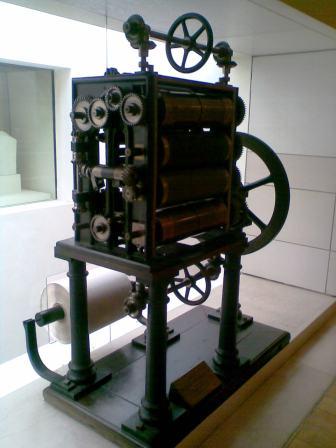
Next to this strange contraption in the Museum, the first successful rotary printing press, there is a video detailing the first 500 years of printing. For the character in this sestude, the past 50 years have been hard to accept.

The first 5OØ Years of Printing


‘This is where the dye was cast,’ Maureen sulks, recalling her long days in the pool. Not exactly stereotyping – this was surround-sound. Banging memos into waxy stencils; clanking out copies on the office Gestetner. First, the golf-ball; the daisy-wheel, the ink-jet, now laser printers churn out photographs – in colour even.

‘Is this “progress”?’ sighs Maureen, feeling obsolete. ‘Or history in the making?’