Wednesday, 31 October 2012

All that is not Holy

Last Saturday evening, returning late from a short trip to Englandshire, I found Auld Reekie full of revellers; adults up to nae guid, pretending to be children, or scary, or sober (not.)  It was a premature celebration of tonight’s shenanigans which, like everything else these days, have been eclipsed by commercialism and alcohol.

I always considered Halloween as American as popcorn and pumpkins (I blame Charlie Brown.)  But hold on: the Scots invented ‘guising’ long before ‘trick-or-treat;’ we have apple-dooking, not bobbing; we have neeps, not pumpkin. And thanks to The Bard,  ‘Of brownyis and bogillis’ we have the greatest haunted tale in the book.

But Hallowe’en (ooh, hallo apostrophe), the Eve of All Saints, was stolen from The Church – which probably stole it from some other pagan rite in its turn.

Something I miss, now that I no longer perform the church’s daily office (liturgical, not administrative) is singing some of the most extraordinary poetry each day.  The Psalms contain an incredibly rich palette of images and beautiful language, in which one gets to sing, in plainsong, chant or hymnody, about things like how a man ‘delighteth not in any mans legs, nor in the pleasure of an horse.’

A favourite of mine is the 59th, in which the heathen ‘Grin like a dog and go about the city.’  This gives any organist an opportunity to paint the words with whatever strange registration they have available.  I thought of this line when I saw (in the Museum of Scotland – where else!) the fabulous wrought iron dog, a boot-scraper, designed by the iron-mongers, Haddons of Murrayfield. And this is the sestude I wrote in response.


Mischief

Scrape of their feet on the grate,
squeak of a gate, rattle of chains;
a clattering heralds their motley state.

They stand in shop-bought deceit,
fake-blood-stained sheets; piercing through
eye-holes announce: Trick or Treat.

Lacking either, I set the dog on them.
Petrified, he turns to stone; frozen, grins
with wrought-iron fear, inane or immune.

So they wipe their feet with him.

Sunday, 14 October 2012

Lowering the Toner

On one of the rare, recent occasions I was printing stuff from my computer, a message flashed up: LOW TONER: PURCHASE NEW CARTRIDGE. However, I know the trick of removing said cartridge and giving it a wee shoogle. Hey presto, printer-magic. It’s not exactly high-tech, though. Computers and all their associated paraphernalia have never failed to confound me.

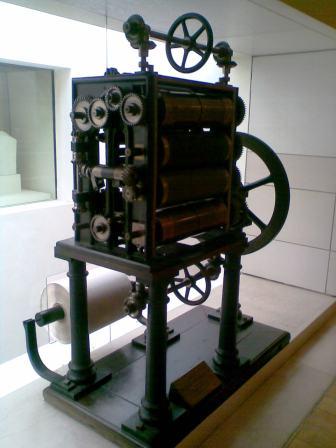
When I think back on the days when printing ten pages took as many minutes on a printer that weighed half a tonne and sounded like a machine-gun, I continue to be amazed at what printers can produce at the click of a moose.

Next to this strange contraption in the Museum, the first successful rotary printing press, there is a video detailing the first 500 years of printing. For the character in this sestude, the past 50 years have been hard to accept.

The first 5OØ Years of Printing


‘This is where the dye was cast,’ Maureen sulks, recalling her long days in the pool. Not exactly stereotyping – this was surround-sound. Banging memos into waxy stencils; clanking out copies on the office Gestetner. First, the golf-ball; the daisy-wheel, the ink-jet, now laser printers churn out photographs – in colour even.

‘Is this “progress”?’ sighs Maureen, feeling obsolete. ‘Or history in the making?’


Wednesday, 26 September 2012

Money for Old Rope

The other day I had a letter from the people who clean the close in my block of flats, basically blackmailing me to pay for a service that I didn’t request.  Why so stingy, I hear you ask? 

Well first, because I don’t believe there is anything in my title deeds saying that I should line the pockets of people who do the job far less well than I used to.  And since I was the only person on my stair who ever swept it out (I’m on the ground floor, mind you) I would rather revert to the old system, as illustrated in this sign on the top floor of ‘Oor Museum.’


Far be it for me to moan on about the perils of capitalism and greed. The bucket and mop next to the sign reminded me of one of our most-beloved characters, and a distant memory of a cartoon picture with empty pockets pulled out of his troosers; an exasperated look on his wee face.  This was my response.


Pocket-Lining

Oor Wullie’s a bit of an entrepreneur
(though he dis’nae ken what that means.)
He went to the Pound Shop, bought a
new mop; filled up his bucket with water
and soap-suds and scrubbed every doorstop,
charging a shilling-a-piece, and ten bob
for each close he cleans.
If only he’d learned to sew up his pockets
before he dropped all his profits.

Friday, 7 September 2012

Long Way Down

You get to see – and hear – some funny things as you wander through the Museum.  The other day, a couple of kids on the fourth floor, as they crossed a “bridge” looked down at the drop to level ‘0’ and one said, ‘Wouldn’t it be cool to jump down there!’  About a month ago, I too looked down, and saw a couple of workers taking pieces of the horse skeleton that lies in a glass case at the bottom of this drop, presumably performing some kind of restorative process on the bones. 

And I thought: yes, that’s how most of us deal with history.  We preserve it; give it a polish, and present it to the present with a contemporary sheen.  As long as we can gloss over the past and put it in a glass case, we can distance ourselves from the humans behind the story.  But their story isn’t likely to be much different from ours.  This horse came to a pretty pitiful end – it’s likely it was hamstrung and slaughtered, a sacrifice to honour the dead, or as a propitiation to the gods. 

I wonder if, in 500 years, museums will look back on the 20th century and baulk at the things that were done in the name of religious fanaticism, political ideology or ridiculous superstition. Or will they, as this century, this new millennium, seems to be suggesting, carry on abusing animals, minerals, the planet and our fellow human beings with unending, unremitting lunacy?  I wouldn’t wish it on my kids.  But history can teach us nothing.

Horrible History

Those Vikings had some
horrible ways; pillaging and
raping with their elongated boats
and horny helmets: the stuff
of comic books and cartoons. 
But flog a dead horse?
This equine specimen,
encased with nuts and bolts,
from four floors up looks like
he was thrown from history,
straight into the 20th Century
 – a fate far worse than
anything the Vikings could do.

Friday, 24 August 2012

Shout Out

Today’s Festival Treasure-inspired sestude is about a spiky comb called a ‘heckle,’ used for teasing out the tough fibres before spinning and weaving the flax into cloth. This gave its name to the interruption and debate that occurred among the belligerent workers in the Dundee flaxworks when the daily news was read out by one of the workforce.  Now, I don’t tend to shout-out other blogs, sites or twitterati, but I think today is the right time.

Even outwith the manic month of August, Edinburgh boasts a vibrant spoken-word scene.  Poetry-readings, story-telling, mini-festivals and random literary gatherings occur unerringly throughout the year.  Well it’s no wonder: we are the first UNESCO City of Literature http://www.cityofliterature.com/index.aspx?sec=1&pid=1, home of the Scottish Book Trust, http://www.scottishbooktrust.com/ and the Scottish Poetry Library http://www.scottishpoetrylibrary.org.uk/. 

Last month, I performed one of my short stories at the Storytelling Centre www.scottishstorytellingcentre.co.uk and participated at Red Squirrel’s monthly ’10-Red’ event (here endeth anonymity) http://www.youtube.com/watch?v=tKCuHbrGf9o&feature=share. I could reel off a handful of other regular events, but the lovely @auntyemily has written perfectly adequately (and less waffly) on the subject: http://auntyemily.wordpress.com/2012/06/30/what-is-spoken-word/

At a recent poetry workshop, somebody asked if people ever heckle at poetry readings.  The general consensus was, no.  But yesterday, at an event that was part of the Festival of Spirituality and Peace https://sites.google.com/site/stephgreen1/poetry-in-the-persian-tent Jackie Kay was, I think it’s fair to say, heckled by our own national poet, the Makar, Liz Lochhead, regarding her pronunciation of the word, “Quaich.”  Quick as a flash, she rhymed it with ‘quiche’ – which made me think she’d read the April entry of this blog http://throughtheturretwindow.blogspot.co.uk/2012/02/drinking-in-edinburgh.html  But no. Even so, I hope she reads this.

And if, with all these links, since I’m now onto the 17th sestude of the year, there is any confusion over what constitutes a ‘sestude;’ or if you are unclear about where I got the idea of completing 26 of them, here is the final shout-out: http://www.26treasures.com/

Anyway, that’s quite enough interruption: here’s this week’s picture-and-poem…


An Epic, Homeric Hackle

Pretty Penelope sits with her heckle,
a bit of a Jekyll and Hyde.
Every day she teases her flax,
combs it and spins it,
winds it onto the loom.
By night she unravels her garment of gloom,
resigned to be left on the shelf,
returns to her former, single self
until somebody shouts,
‘Oi, you with the freckles:
get on with it!’

Wednesday, 15 August 2012

Money, so they say

Over half-way through the Fringe, and I have not yet tired of wandering along the Royal Mile and having flyers thrust at me by not-unattractive drama-students shouting out, “Five-star reviews in the…” and there you can insert whatever crappy publication that employs hacks to review things about which they know little. Mostly. 

While I will happily blog, comment upon, give thoughts and feedback, and even my opinions, unless I am writing about something on which I have specific and relevant background knowledge I will not pretend to be a “critic.”  I would urge all people to analyse deeply what a “critic” is saying before choosing not to attend a performance.

But public opinion, even in these days of increasingly discredited journalism, is a real force.  Everyone who has the guts to put on a show during the Fringe, however mediocre or unpolished, deserves applause.  These up-and-coming-or-otherwise-hopefuls need stars, just as they need to learn to dismiss those who pan their efforts. 

If Art is the lie that helps us to understand the Truth, I’m not sure what journalism, steeped in mendacity, hypocrisy, half-baked facts and spurious agendas, stands for.

Morals? Hardly. Art? Nah. Money? Probably. If so, they can keep it.
I believe in Art.

Render unto Caesar.

Pontius Pilate has the best lines in the book:
‘What is Truth;’ ‘What I’ve written I have written;’
and something else about a mango. 
Keen on personal hygiene, he’s always washing his hands;
and – rare for a Roman – listens to his Missus
(though her sage advice he dismisses.)
So why such bad press for the Puppeted Politician?
A fickle thing, Public Opinion.

Monday, 6 August 2012

Busy Times

There’s too much going on at the moment, and not enough days in the week, hours in the day, minutes in the et cetera.  Some sort of Sports-Day thing in London, the Proms on the Radio, and here in Edinburgh: well, where do we start? 

This time last year, amid the Festival Frenzy, the refurbished National Museum of Scotland re-opened its Old Building after many years and was mobbed with visitors.  My only regret (and I feel bad for saying this) was that the Millennium Clock Tower was banished to a siding, like an old train, and now competes with a tacky golden cockroach.

So for the first of my Festival Sestudes, and to wish the National Museum a slightly-belated happy 1st Birthday, I will make a rare exception and venture out of the Scottish Building. Here, slightly perversely, is a before-and-after-time pair of pictures.


Such is Time

I cranked into action. Crowds
gathered as music began.
Two little children ran
like mischievous mice.
“Mum, you’ve got to see the clock:
it’s amazing!”
But time is fleet-footed, ephemeral.
I used to command an audience
the full length of the room –
even the fish stopped to look –
sometimes they’d applaud.
Now they’re gone, and I’ve been
exiled; shunted into dry dock.

Images Copyright M J Richardson. This work is licensed under the Creative Commons Attribution-Share Alike 2.0 Generic Licence.