Friday, 15 April 2011

Happy Birthday to Moo!

Today was the birthday of a particularly special friend of mine, whose love of cows not only helped me to blag our way into the launch party of the Edinburgh Cow Parade, but also inspired me to write this poem (about her, perhaps, or another friend, both of whose names are disguised by epithets in the dedication.)

Triolet for a Cowgirl


For ‘Cassie’ and ‘Ethel’

The day the painted cows paraded through
you wore your hair up in a pony-tail.
This isn’t how I pictured you
the day the painted cows paraded through
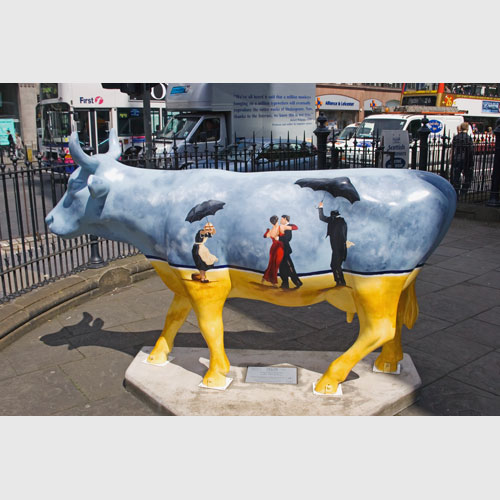
beside our chosen bovine Vettriamoo1.
I swore, for sure, you wore your hair in pig-tails.
But no: the day the cows paraded through
you wore your hair up in a pony-tail?


Note:
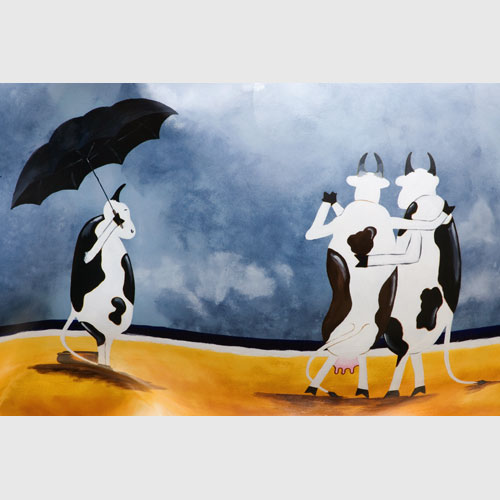
1 For fun, the final syllable of ‘Vettriamoo’ should be given the fullest stress. This cow, based on Vettriano's painting, ‘The Singing Butler,’ stood outside St John's Church, on the corner of Princes Street and Lothian Road during the Edinburgh Cow Parade of 2006. (My picture was taken at the Launch Party - note the glass of wine by her left foot!)  The artist who designed and painted it wanted to name her cow ‘Vettriamoo’ but her sponsors wouldn’t let her.  My poem pays homage to the artist, Ginie Naisby, and so many happy (but fading) memories. 


Saturday, 26 March 2011

Switches

This is the second of my Glasgow Schooldays pictures: old-fashioned light-fittings found in the Scotland Street School Museum.  The title of the picture, you might spot, is a play on words: doubtless the pupils in those days may have been subjected to a different sort of switch. 

Today, as the clocks spring forward, I marvel at how everything can suddenly change at the flick of a switch, or at the perilous press of that button marked *send*

Monday, 14 March 2011

Happy Birthday to Me!

On this inauspicious day, perhaps I should consider where it all began. No, not my strange little life; my even stranger obsession with the phone-box.  And what better than to post a picture of the first red phone-box that I would have seen, at the top of our little cul-de-sac in a quaint little village in the Home Counties?  Except that I can’t – and this is the point – because it is no longer there.

Besides, it wasn’t even a proper one; it was some distance from the award-winning Gilbert Scott with square windows and, for ventilation, a perforated crown in the semi-domed top.  The only thing linking our box with the London Classic was the smell of piss: it was one of solid 1970s jobs, with single-glass panels on three sides, vandal-proofed, with a door so heavy that it rendered an emergency-call a trial. 

When BT took over the GPO in the ‘80s, our village got chrome-and-perspex replacements, while the next village down the A1 managed, somehow, to hold on to a little bit of our Great British Aesthetic Heritage and kept their Red Box.  I believe it still stands.  At least, it was there last time I passed through, just a couple of years ago.  But a lot can happen in a couple of years. 

The phone-box is a potent symbol of the past; what the future holds for it, who knows – except the usual death and decay.  But I’m okay with that. The present, however – even on my birthday when it ought to be a welcome gift – it’s the present that scares me the most.

Monday, 28 February 2011

February Phone Box

Before this short month ends, here is the first, the topmost, phone-box. It is, for those who might detect a slight obsession, significant in one regard: the most northerly phone-box of the British Isles, located on Unst, which is part of Shetland.

Of the hundreds of phone-box pictures that I have taken, this has to be one of my favourites, not only for its significance, but the memory of the trip, the friends I spent time with, and the fact that during a week of sideways rain (as mostly happens on Shetland) we found this famous kiosk just as the sun was setting, pale and bright, on a chilly autumn evening.

The Caller shall remain, of course, anonymous (although his name begins with 'A')

Wednesday, 26 January 2011

Photos, Foxes, and lots of Phone Boxes

This year, I shall be mostly posting photos – and the occasional poem – maybe a fox will intrude.  I might even open a ‘discussion’ on phone-boxes.  But to start with, the first of a selection of photos that I took in Glasgow, and made into a calendar for my Dad: pictures to remind him of his school days, many years ago.  His old school is now a Business Centre; his old home (its memory) lies beneath a certain busy road. Misty, water-colour memories? But not in black and white…


Monday, 20 December 2010

DECEMBER - Her Winter Houses Moon

Before the full moon wanes its wintry way towards the shortest day, and the days themselves descend towards the year’s end, here is my final contribution.

I began this year’s blog entries by saying that one oughtn’t to ‘explain’ a poem - then went on to do just that!  This, the last piece of my twelve-poem cycle, An Imaginary Menagerie, is possibly the saddest poem I have ever written and, in this respect, perhaps the most personal. Best, then, that I leave it to speak for itself.

If you would like to look up some stuff on Edward Lear, this might give you some of idea of what lay behind the composition. Otherwise, just read it as it is, or interpret it as a photograph, or piece of music, or stone whose meaning is entirely in the eye, or ear, or hands of the beholder.

Moon Phases, December 2010
New Moon – December 5, 17:36
First Quarter – December 13, 13:59
Full Moon – December 21, 08:13
Last Quarter – December 28, 04:18


DECEMBER: Her Winter Houses Moon

The Yonghi-Bonghi-Bo.


Midwinter, and the garden's lake
is petrified to a pool of frozen tears;
a solid silver dish, impenetrable
from above or below by light or dark.

Alone in his Karmic Ivory Tower sits
Lear, with his myriad of nonsenses:
unmarried, impoverished, sedentary,
mind running faster than pulse.

His Eden consists of Bong Trees,
and his serpent less feared or revered
than the Yonghi-bonghi-bo,
Quangle-Wangle, Pobble and Dong.

He named the creatures; his crazy
cosmogony merely a foil to his
sad, self-depricatory sense of humour,
hewn from his ornithological pursuits.

To this end, he refused the fruit,
alleging enforced solitude to be
the sole route to creativity: travel,
his companion, escape his destination.

Yet once, this journey took him to the
land of myth, where one strange siren,
beguiled by the anomaly of his charm
both puerile and old before its time,

attempted to lure Lear from his fantasy.
Threatened by phantasmagorial reality
He ran a mile, preferring to dwell ever
more beneath Her Winter Houses Moon.

And so, regressive and old-fashioned,
unhappily trapped between the
ever after and once upon a time,
he sent out his ridiculous, satirical cat,

to court with wisdom and truth,
in a beautiful pea-green boat.
But now the winter warps the water,
And the Winter House looks out

No longer to a halcyon sea,
or a land of invention and magic:
Only the looking glass, back to front,
mocking Her moon's distorted image.

Sunday, 21 November 2010

NOVEMBER - Freezing Moon

Well, we’re nearing the end of this year of lunar-dictated poem-blogs (or should that be, moon-plogs?)  And as the evenings continue drawing in, and the streets are paved with grit, this certainly is the month of a freezing moon – in Scotland’s Central Belt if not the Native Lands of the North American Tribes.  November is also the month of the dead, when people remember saints and souls, certain martyrs and those who died while killing others or defending an allegiance.

If only we could defend the lives of threatened species as well as we defend a flag. Whether these beasts are mythical or really existed is neither here nor there: the loss of any animal, plant, or human life is a tragedy of epic proportion.  God forbid we should lose the gift of empathy that stems from our utmost unique faculty, the Imagination.  But then, it is this loss (or suspension, or suppression) that enables people to fight wars for what they think is right.

Rights are neither here nor there. Death is final, whosever side you’re on.


Moon Phases, November 2010
New Moon – November 6, 04:52
First Quarter – November 13, 16:39
Full Moon – November 21, 17:27
Last Quarter – November 28, 20:36


The Unicorn


A few hundred million years since the dinosaur
was duped by catastrophism, erased by uniformitarianism,
or when the sun's own sister showed her dark side,
and sent cataclysmic hell-showers upon our frozen earth,
a smarter race appeared to test supremacy,
and assist the mutually assured destruction of nature's gentle tide.
And yet the dinosaur is only marginally older than the
contents of the ark: it stands for simply that, an age gone by.

The Dodo has a more difficult time, immortalised
not by its quirky life or shape, but symbolising
in figure of speech the bleak reality of its demise.
Similarly the fate of the tiger, the tusks of the elephant,
and horn of the great white rhino fall prey to lies
which pamper to fallacy, greed, and pallid vanity:
to be hounded out of existence by spurious design.

Perhaps the phallic unicorn evolved
from what was first deemed good:
its epic strength and tender beauty held androgyny
in balance with grace like a mythical god.

But when this horned equestrian
- one of nature's true vegetarians -
gently nudged the fruit with his miracle tool
(which once had the power to quell raging waters -
A wasted potential) he inadvertently speared it.

A kindly, nubile and nymphomaniacal creature
took both the seed and protuberant weapon,
ate the fruit, then purporting it's aphrodisiacal nature,
ground the horn into a paste, inflating the alleged
membership of her race, whereupon

the Unicorn, demoted from ecclesiastical equus
to Grecian bucolis, as punishment for its innocence,
was denied a place on one man's microcosmic paradise.
Denuded and disempowered of its former potency
it perished the ultimate sentence in the deluvian purge.

Had the moon been full when the rain fell,
and had the floods that lifted that floating zoo
been petrified by the freezing moon of the Lakota Sioux,
it might not have preserved the frozen myth,
or the memory of an imaginary menagerie,

but as blocks of ice from God's deep freeze thawed
six hundred million years later, four thousand winters,
or a drop-in-the-ocean millennia or two,
the global warmth might have revealed the truth.

This story is thus;
the punishment of death for good,
whether innocent, naïve, or just plain thick -
it matters as little to us.
Like death, extinct is for ever.
- As the dodo, an irreversible trick.